What are ketones?
Ketone bodies, or more commonly known as ketones are three water soluble chemicals that are produced when fatty acids are broken down in excess in the liver and kidney. The production of these compounds is called “ketogenesis”, and this is necessary in small amounts. Ketones are transported across the inner mitochondrial membrane as well as across the blood-brain barrier and the cell membranes. Ketones can become dangerous if too many are produced in the body (ketoacidosis). This is because they are acids, and can lower the bodies pH to dangerously acidic levels. (Brown, “Ketone”, 2019)
Chemical Structure

Ketone bodies are any class of organic compounds that are classified when a carbon atom is covalently bonded with an oxygen atom. As well, the two remaining bonds are carbon atoms or hydrocarbon radicals. (Brown, “Ketone”, 2019)
The three ketone bodies are:
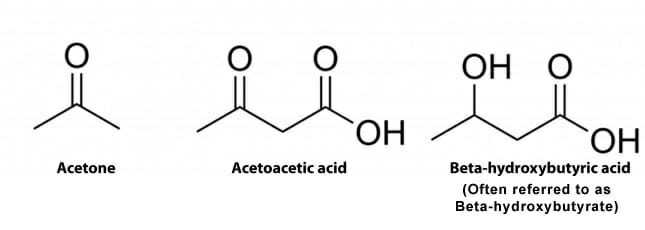
- Acetoacetic acid: produced from the breakdown of fatty acids, converted into beta-hydroxybutyrate or acetone.
- Beta-hydroxybutyrate: formed from acetoacetate, not the structure of a ketone, but is considered a ketone because of the keto diet.
- Acetone: produces a side product of acetoacetate, and can be quickly broken down. Is discarded from the body through urine or breath. (Khambatta, “What are Ketones: Your Brain’s Best Friend or Worst Enemy?”, 2018)
Importance During Ketosis
Ketones are important during the processes of ketosis as without them the body would not have a source of fuel. Let me explain, if glucose was not available in the body, ketones must be present for the body to produce energy, or else the body could not survive. (Khambatta, “What are Ketones: Your Brain’s Best Friend or Worst Enemy?”, 2018)
 Ketogenic Diet